The chemicals industry's road to climate neutrality
Transforming the chemical industry towards climate neutrality is one of the most challenging tasks in industrial decarbonisation. As an energy-intensive industry that is closely woven into global value chains, it is both a major emitter of greenhouse gases and a key enabler of sustainable technologies. In his plenary speech, Dr Kai Ehrhardt, Vice President Reaction Engineering and Executive Expert at BASF SE, examined the key elements needed for the chemical industry to achieve net-zero CO2 emissions by 2050, looking at the technological, systemic and economic dimensions.
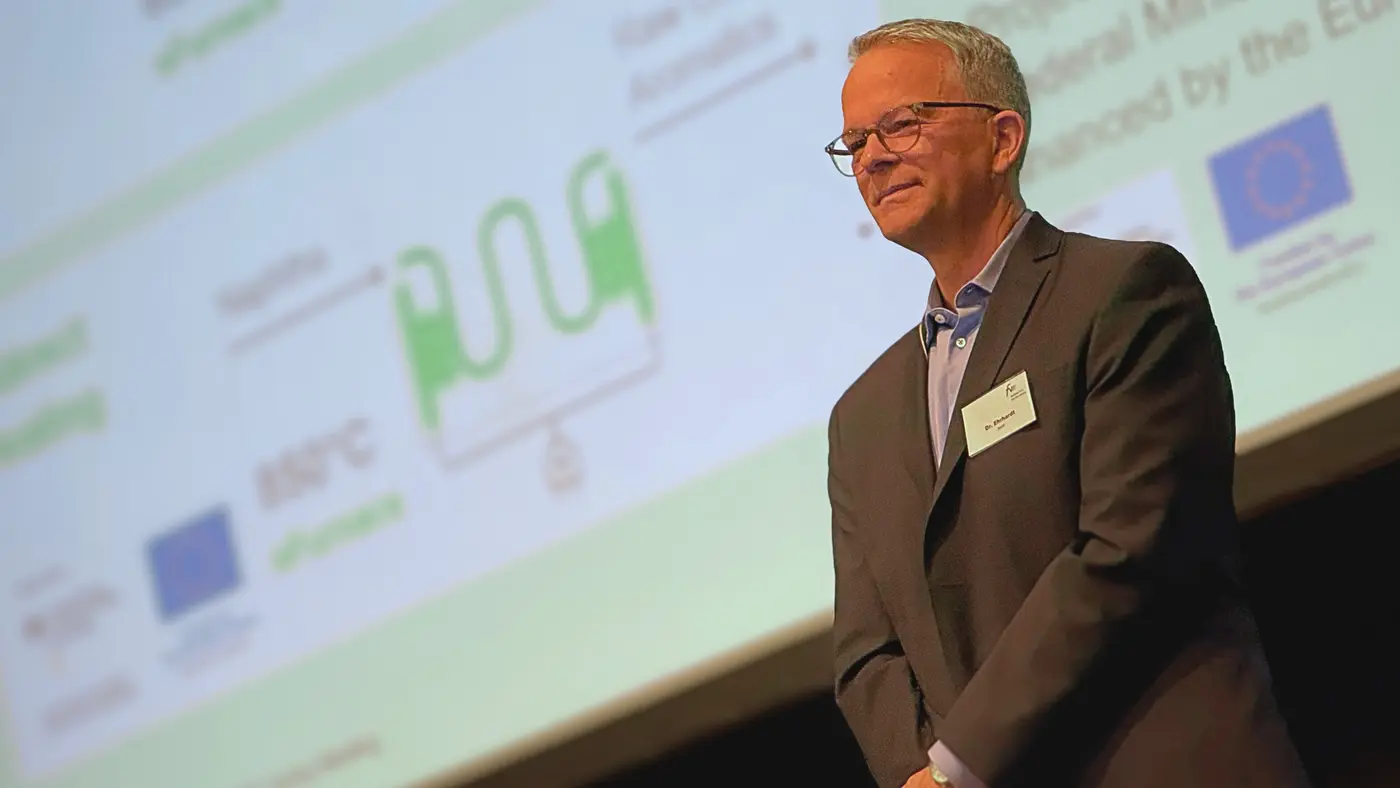
BASF’s strategy is built around a long-term transformation aligned with the EU’s climate targets. The aim is to cut direct and indirect emissions significantly by 2030, before achieving climate neutrality across the entire value chain by 2050. The defossilisation concept lays out a step-by-step reduction in emissions through the use of renewable energy, efficiency gains, low-emission steam generation and new climate-friendly technologies.
Dr. Kai EhrhardtWe are investing hundreds of millions of euros each year in these measures, and we regularly adjust our plans to align with technological and economic developments.
In parallel, the product portfolio is being reshaped towards solutions that deliver measurable sustainability benefits. According to Ehrhardt, this shift is closely tied to market demand, as investments and technological changes are heavily influenced by what customers are willing to pay.
The first step in BASF’s defossilisation plan is to swiftly implement easy-to-deliver optimisations and measures underpinned by a clearly defined business model. The second step is shaped by a focus on market demand. This will be achieved by securing increasing volumes of renewable raw materials and expanding the range of products with sustainable properties to match customer needs. The final step is the reconfiguration of production plants – decarbonising existing plants and investing in competitive new technologies, in perpetual alignment with customer demand and the net-zero targets.
A key element in this is the systematic recording of greenhouse gas emissions along the value chain, so that emissions and emission savings can be documented transparently. Digital tools make it possible to calculate emissions for a large number of products, taking into account process energy, raw materials and upstream emissions from suppliers – which at BASF account for around 50% of total emissions. This information matters not only for internal optimisations, but is also relevant for customer decision-making and regulatory requirements.

Technological and systemic approaches
Switching the chemical industry’s raw-material base is a central pillar of the transformation. BASF is increasingly moving away from fossil sources towards renewable sources and circular carbon solutions. This includes both the use of bio-based materials and the integration of recycling flows. These more environmentally friendly raw materials are typically processed alongside conventional base products in existing plants, with the share of bio-based and recycled materials accounted for via the mass balance approach. »This method allows sustainable raw materials to be allocated to specific products on paper, without having to fully separate the physical material flows. This enables a gradual economic transformation while still making use of the existing infrastructure,« explained Ehrhardt.
BASF is concentrating its decarbonisation efforts in particular on key processes at the start of industrial value chains, as this is where the greatest emissions reduction potential lies. A range of technological options is available for these processes, each assessed on the basis of efficiency, costs and investment needs. Alongside electrification, the use of hydrogen and processes for carbon capture and storage also play a key role.
Hydrogen as a feedstock and energy carrier
In many sectors, such as transport, hydrogen is primarily seen as a potential molecular energy carrier. The chemical industry, however, needs hydrogen on a large scale as a process gas, given the molecular make-up of the chemical products it manufactures. »What is critical in this context is that hydrogen is more valuable when used as a process gas than when it is burned for heat,« explained Ehrhardt. Furthermore, if fossil feedstocks such as natural gas or naphtha are phased out altogether or used only to a limited extent, and replaced by biogenic feedstocks, recyclates or CO2, the demand for hydrogen will rise further. Providing green hydrogen via electrolysis is energy intensive and presents real challenges in terms of scaling and cost. Alternative routes such as methane pyrolysis offer promising prospects here, as they can produce hydrogen with comparatively low energy input and very low carbon dioxide emissions.
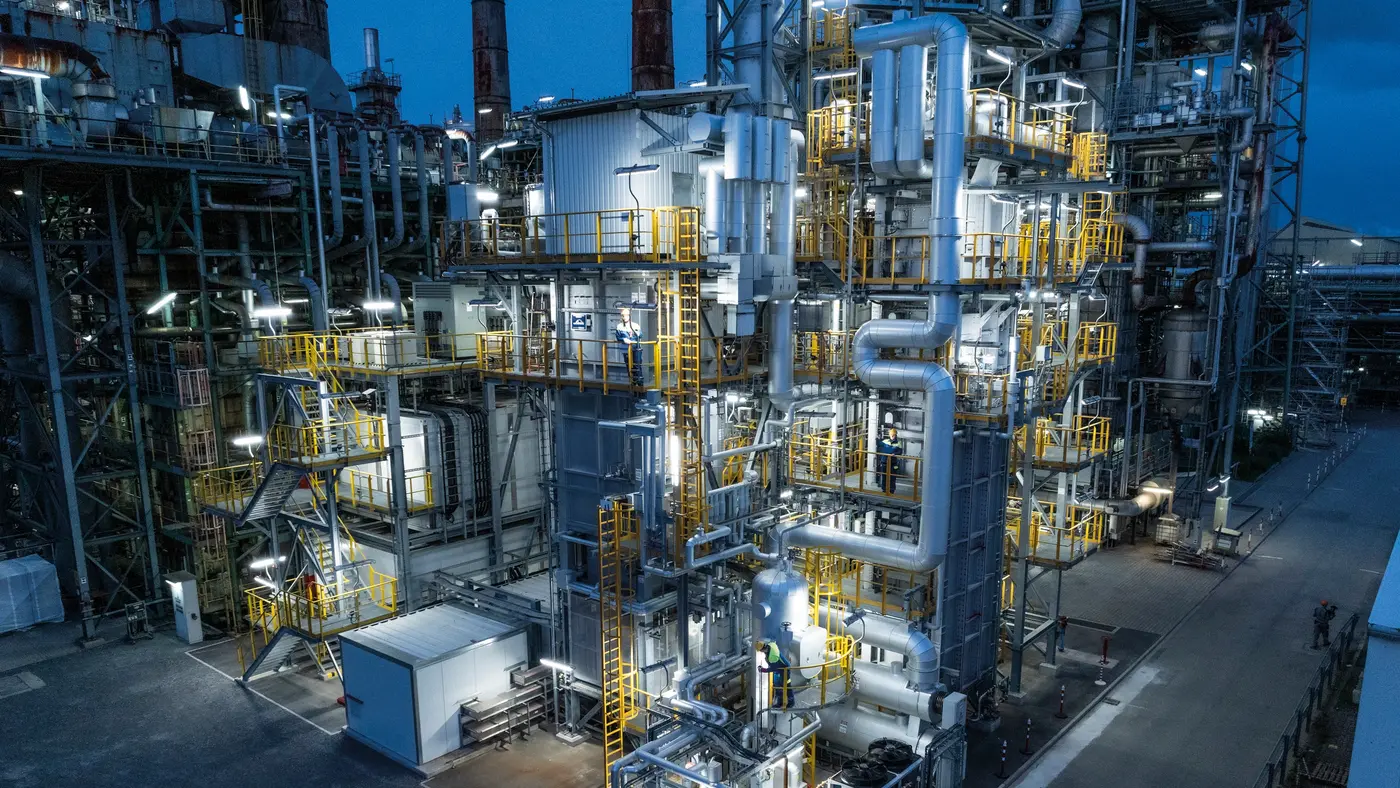
In parallel, the electrification of chemical processes is becoming increasingly important. A broad supply of renewable electricity is essential for this. Given the sheer scale of their emissions, energy intensive key processes are a particular focus – such as steam cracking, in which long-chain hydrocarbons are thermally broken down into short-chain molecules through the addition of superheated steam. New sites and production plants offer the opportunity to integrate innovative technologies from the outset and so achieve significantly lower emissions than conventional plants. Significant progress can be made by combining renewable energy supply sources, electrified processes and integrated material cycles. »One example is our new Verbund site at Zhanjiang in southern China. There, we are using state-of-the art technologies that allow us to cut the carbon footprint by around 50 % compared with a conventional gas-fired petrochemical site,« said Ehrhardt. At the same time, transforming existing plants remains a central challenge, as these account for the bulk of current production capacity. A large-scale heat pump system for harnessing waste heat is set to begin operations at the Ludwigshafen site in 2027. Converting waste process heat from the steam cracker into usable steam can significantly cut the use of fossil fuels. In conventional superheated steam generation in boilers, switching from natural gas to alternative energy sources such as electricity or hydrogen also offers reducing emissions.
Dr. Kai EhrhardtWe expect green hydrogen to remain comparably scarce and expensive for the foreseeable future. Because we urgently need it as a process gas, our focus lies on electrifying steam generation and on direct electric heating of chemical processes.
For emissions that are technically hard to avoid, carbon capture and storage is an essential complement. Implementing solutions of this kind, however, will require suitable regulatory frameworks and the development of the corresponding transport and storage infrastructure, Ehrhardt noted. International cooperation, he added, is pivotal here, as suitable storage sites are not available in every region and such cooperation allows for more economical scaling.
Transformation has to be economically viable
As the keynote made clear, decarbonising the chemicals industry is a complex, long-term process that combines technological innovation, systemic integration and the economic framework. Success will hinge largely on how well efficiency gains, new technologies and shifting market dynamics can be married into a coherent transformation pathway. The chemical industry has a pivotal role to play in this regard, as its products and processes have an impact well beyond the sector itself and can therefore make a decisive contribution to global climate neutrality. In addition to the technological aspects, the economic dimension is also crucial. The transformation calls for significant investment and pushes up manufacturing costs, while the willingness to pay for sustainable products is currently limited. »This creates a tension between environmental goals and economic viability. Policy instruments such as carbon pricing, regulation and funding programmes can support the green transformation, but they have economic consequences and shape global competition,« said Ehrhardt. //