Taking an active role in shaping change
Copper, copper alloys and their joints play a crucial role in the performance of electric powertrains, both in development and production. What is missing, however, is design methods for joints. Professor Anna Trauth is conducting research into this topic in an FVV project at TU Darmstadt.
Her path appears to have been set early: »We have always joked that the first thing I learned as a
child was how a car engine works,« says Anna Trauth. She spent time building model planes with
her father, and had a keen interest in technology from a young age. At school, she excelled in science
subjects.
She thought about studying physics, but was not sure what a career as a physicist looked like. She finally opted to study Sports Engineering at TU Chemnitz, as the combination of sport and technology suited her interests better. What has followed is an impressive scientific career with a clear guiding principle: her interest in materials. »It started during my bachelor’s degree, when I first heard about polymer-based fibre composites. They are used in sports equipment, for example. I found it fascinating that it is possible to ›design‹ materials specifically to create certain properties and to bring different worlds together,« says Anna Trauth.
To open up more options for her future career, she studied for a bachelor’s degree in mechanical
engineering at the same time. This was more of a pragmatic choice, as she did not see herself as
a conventional mechanical engineer. Nevertheless, she still went on to study for a master’s in mechanical engineering at the renowned Karlsruhe Institute of Technology (KIT). She spent part of her master’s programme studying in France, where she was in good company: »At KIT I was often the
only woman in my lectures; in France it was much more balanced.«
Prof Dr Ing Anna TrauthI found it fascinating that it is possible to ›design‹ materials specifically to create certain properties and to bring different worlds together
In her second year she took on a teaching role and learned that her strengths lie in research and scientific work. She became a research associate at KIT’s Institute for Applied Materials and conducted research as a visiting scholar in the Department of Mechanical, Automotive & Materials Engineering at the University of Windsor in Ontario, Canada.
With her master’s degree in hand, moving into industry was never an option. Instead, she went on to complete her PhD at KIT in 2018 – a doctorate that opened new doors.
Dr Trauth spent five years as Group Leader at the Chair of Hybrid Materials, Institute of Materials
Resource Management (MRM), Augsburg University.
In 2022, she took on an interim professorship there, before being appointed to a full professorship
at TU Darmstadt in 2024. From building model aeroplanes to becoming a professor in her mid-30s
– it could have gone worse.
Lack of design methods for copper
Professor Trauth has taken on scientific leadership of two FVV projects, including a project on the
›Fatigue design concept of copper weldments‹ (FVV project number 1533), which has received
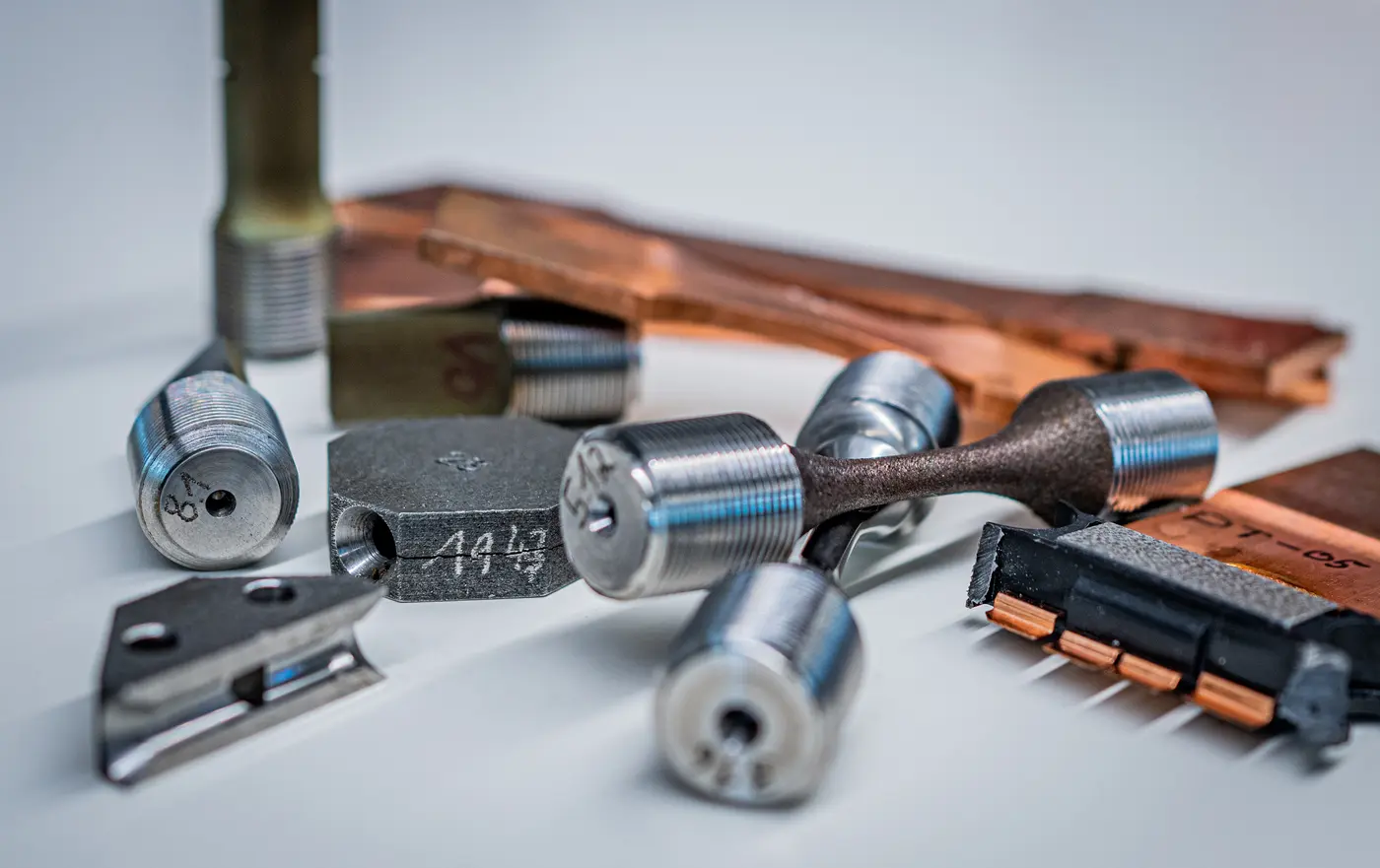
three-quarters of a million euros in funding from the German Federal Ministry of Economic Affairs and Energy. Although the material plays a key role in new powertrain concepts and the mobility transition, few design methods are currently available. »Normally, engineers have a set of guidelines to determine which calculations they need to carry out to ensure the safety of a welded connection or joint. For copper, such design methods do not exist or are very limited, and for the corresponding joints, they do not exist at all,« explains Professor Trauth, outlining the need for research. Yet these methods are needed as part of the design process, she says, in order to enable standardised, user-independent approaches.
Widespread interest across industries
Why doesn’t this data exist? Copper is not a conventional engineering material and, especially when it comes to the fatigue strength examined in the project, very little data is available. In addition, investigating the service life is a very complex and time-consuming task. It is therefore no wonder that there is so much interest in the data across industries, and that the project meetings always include people from a very wide range of disciplines, says Trauth: »It is great that FVV brings so many players to the table. A research association is probably the only way to achieve that.«
In the project, the researchers hope to shorten the conventional route with its numerous lab tests
by identifying models and working with simulations.
According to Trauth, what makes the project fascinating is that it focuses on a concept that can be easily applied in practice. The researchers have now »understood what matters and what information we need. The second step will now be to combine the methods and design processes.« The automotive industry will not be the only sector to benefit from the results, says the professor.
»One of the main goals, and the standard we have set ourselves, is scalability and transferability. This is why we are focusing so much on materials.«
The data could then be used in the development of wind turbines, battery technology and power electronics, for example.
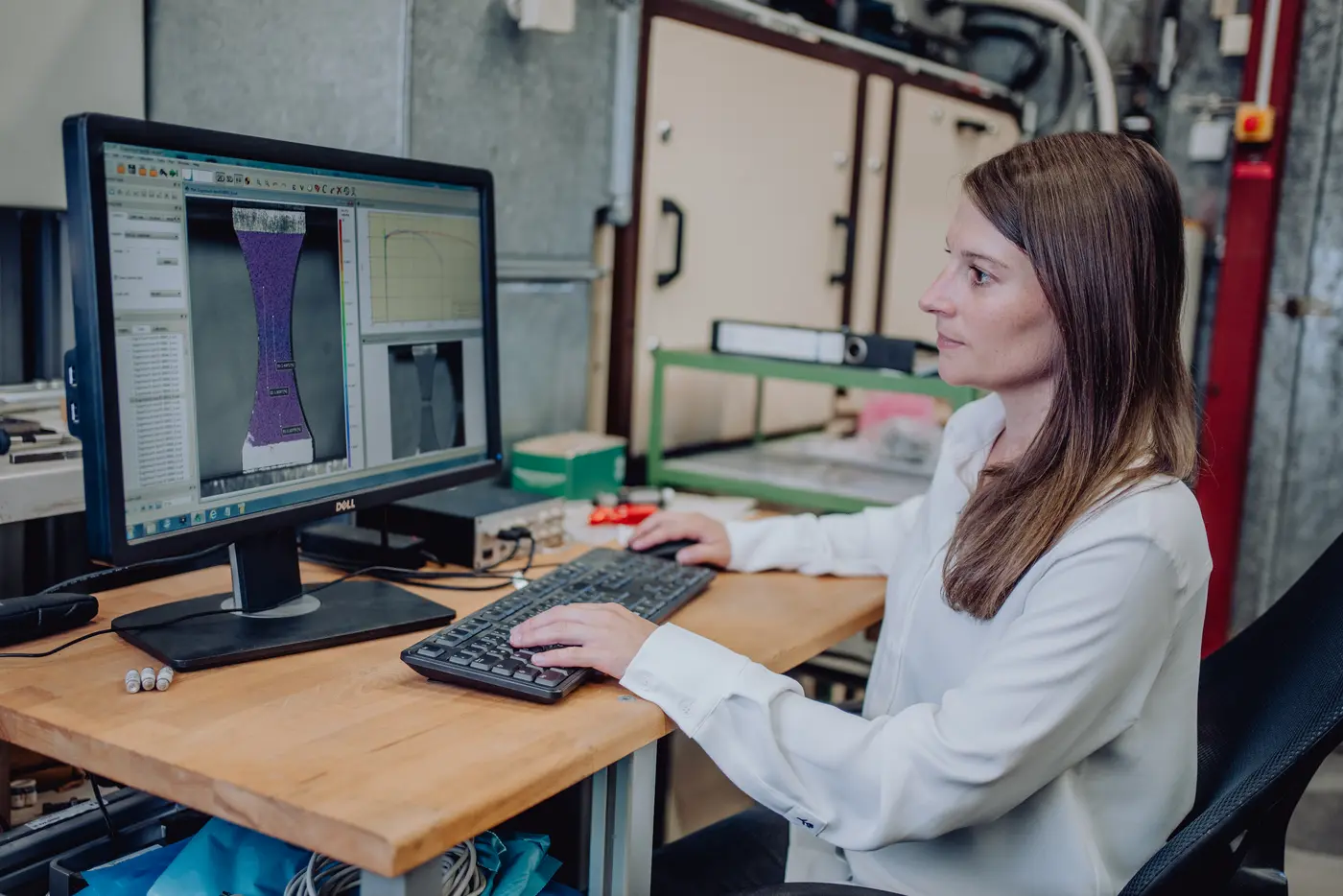
The researchers are also using data-driven intelligence in the project. Professor Trauth says that many of her colleagues at TU Darmstadt make extensive use of these approaches and artificial intelligence in technical fields, both in research and teaching, in order to solve specific technical challenges or conduct calculations. She welcomes the technology as a valuable aid in day-to-day work, but also argues for critical scrutiny: »How does responsibility work? Who ultimately says that the calculation is correct and the component will hold? We cannot ask a computer to do this we always need people to check the results. Unfortunately, I see time and again with students that this does not always happen.«
Raising awareness of the technology’s limits is a major challenge, she says. It is also important to
incorporate the latest research into teaching.
Prof Dr Ing Anna TrauthWho ultimately says that the calculation is correct and the component will hold? We cannot ask a computer to do this, we always need people to check the results.
When it comes to the question of whether she could choose between research and teaching, her ambivalence is clear: »That’s difficult. I hope I never have to choose between the two. But I deliberately chose the academic route back then to focus more on research,« says Trauth. Although she enjoys both, each side also has aspects that »can sometimes be annoying.« Perhaps that is all part of playing an active role in shaping change. The professor wants to play her part in ensuring that things move »in a good direction« in future, not only in terms of technology, but also in society and teaching. Not least for her family, with whom she loves to spend what little free time she has – outside in nature, being active, ideally in the mountains. Ultimately, it’s all about guiding energy in the right direction. //